


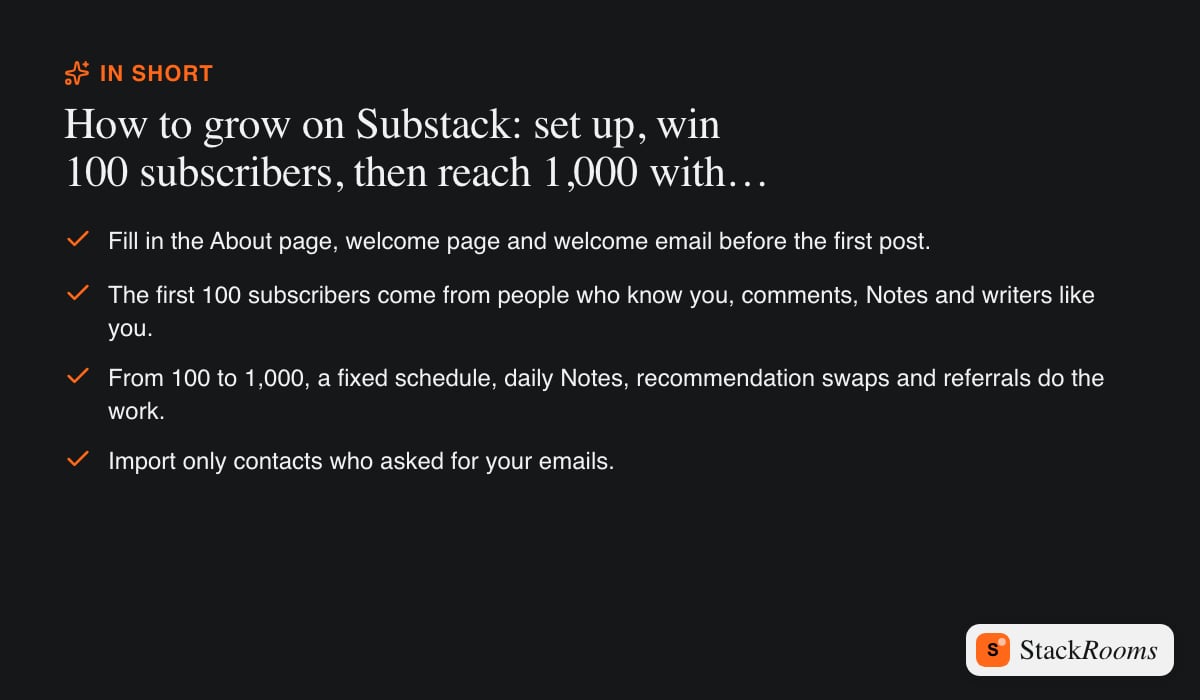
Fill in the About page, welcome page and welcome email before the first post.
- The first 100 subscribers come from people who know you, comments, Notes and writers like you.
- From 100 to 1,000, a fixed schedule, daily Notes, recommendation swaps and referrals do the work.
- Import only contacts who asked for your emails.
- Switch on paid when readers already pledge and you can name what they get.
We have spent more than 10 years growing accounts on social networks and gathered more than 10 billion reach. A new Substack grows the same way: in stages, each with its own work.
Stage 0: a stranger should subscribe within seconds of arriving
- Name and one-line description: what you write about and for whom, in plain words.
- About page: what the publication covers, why you are the person to write it, how often you publish and what subscribers get.
- Welcome email: thanks, the publishing day, two or three posts to read first and one question they can answer by hitting reply. Replies show who your readers are.
- Subscribe buttons: one in the middle and one at the end of every post, for the people who land on a single post from a link.
Stage 1: the first 100 subscribers come from people
Publish three or four free posts first, so a visitor sees what they would get. Make each one useful alone, then keep a weekly day. About five to eight hours a week.
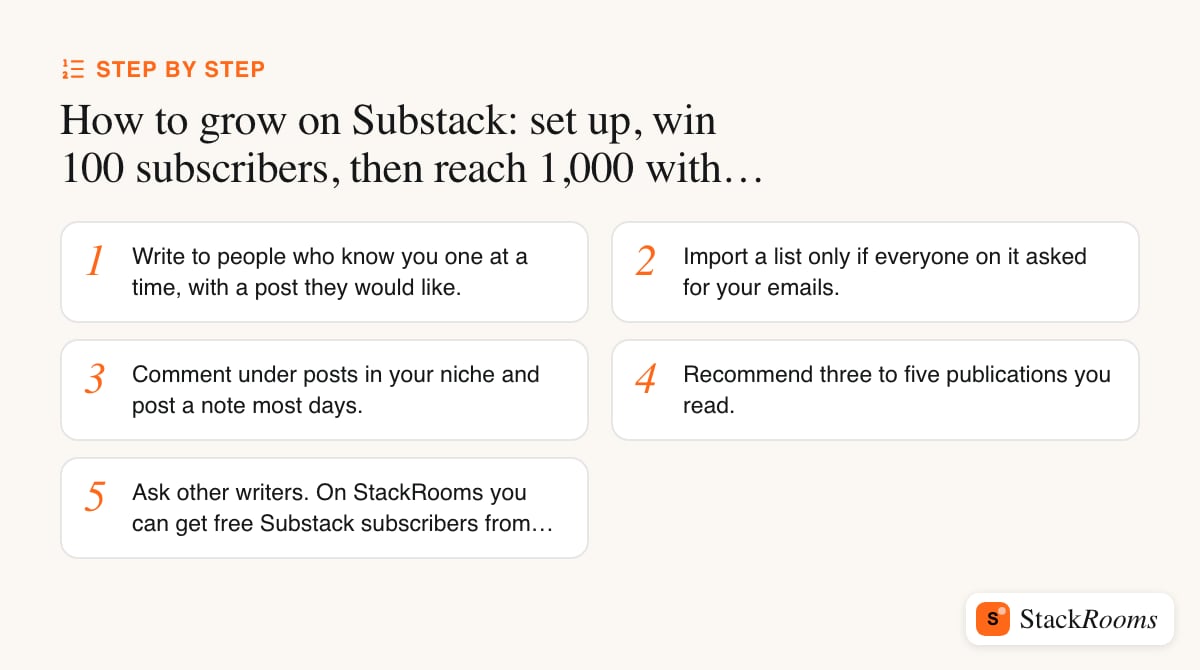
- Write to people who know you one at a time, with a post they would like.
- Import a list only if everyone on it asked for your emails. Bought or scraped addresses never open, mark you as spam and drag every number down.
- Comment under posts in your niche and post a note most days. Readers click a name they keep seeing.
- Recommend three to five publications you read. The writers you pick are told and often return the favor.
- Ask other writers. On StackRooms you can get free Substack subscribers from verified writers. Yes, free, with no bots and no conditions. They visit your publication on Substack and subscribe from their own accounts when the topic fits. Pick readers who will open your emails.
Move on when strangers you cannot trace to your own outreach appear on the list.
Stage 2: from 100 to 1,000, strangers become the main source
Eight to twelve hours a week. Your stats show which posts brought subscribers, so write more of those.
- Turn winners into formats: a monthly roundup, a numbered series, a reader Q&A. A series gives people a reason to subscribe before the next part.
- Notes every day: one or two standalone ideas. View stats on each note shows which kinds bring subscribers.
- Swap recommendations and guest posts with writers your size whose readers overlap with yours. Swapping subscriptions can help too, see Substack sub for sub.
- Turn on subscriber referrals. Each reader gets a personal link and rewards at levels you choose.
- Test titles once you pass 200 subscribers, and put the words people search for in titles and subtitles.
Reactions in the first hour decide how far each post goes. Writers who like, restack and comment early carry it into more feeds, see how to promote your Substack for every channel. To see when you reach a target at your pace, use the Substack subscriber growth calculator.
Stage 3: go paid when readers already ask
Pledges are on for free Substacks, and readers can promise to pay before you charge anything. Go paid when pledges arrive unprompted, open rates are steady, and you can name what paying readers get that free ones don't and deliver it every week. Open Settings, then Payments, connect Stripe and switch payments on. Keep most posts free, because free posts are what new readers find and share. Our Substack revenue calculator shows what you would keep.
What slows growth down
- A new topic every week.
- Gaps in the schedule after a strong start.
- Imported contacts who never asked for your emails.
- Recommending big names who never notice, instead of peers.
- Paid switched on before readers know what they would pay for.
The plan on one page
| Stage | Weekly time | Main work | Move on when |
|---|---|---|---|
| 0. Setup | One afternoon | Description, About, welcome email, buttons | A stranger can say what you write |
| 1. First 100 | 5 to 8 hours | Weekly posts, outreach, comments, Notes, writers | Strangers on the list |
| 2. 100 to 1,000 | 8 to 12 hours | Series, daily Notes, swaps, referrals | Most new readers come from the network |
| 3. Paid | Plus the paid work | Pledges, Stripe, a clear extra | Paying readers stay |